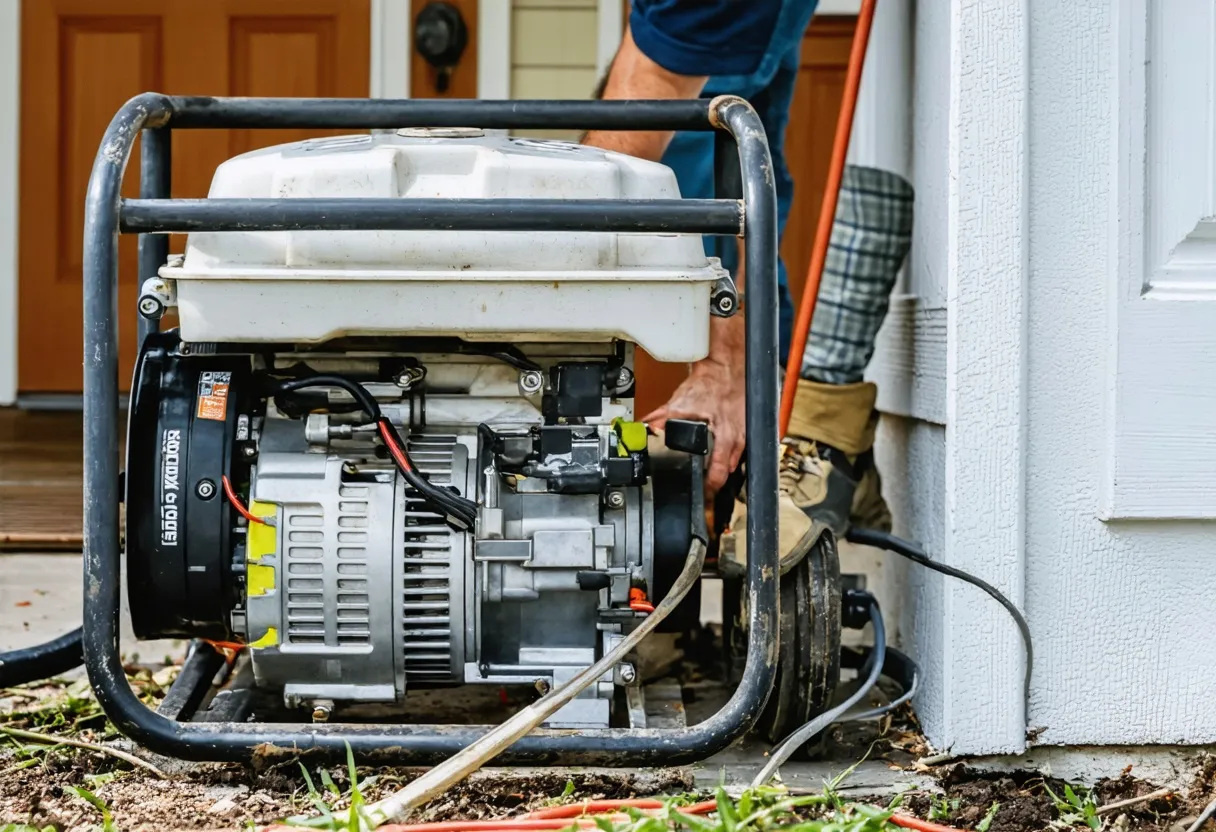
A standby generator that won't crank is a repair call, not a mystery — but too many Birmingham homeowners only find out what's actually wrong after a technician has already been paid to guess. Generator repair in Birmingham works best when the diagnostic comes first, the itemized number comes second, and the sales pitch never comes at all. This page walks through what actually causes a standby unit to fail to start, what a real diagnostic visit looks like step by step, what drives the repair bill up or down, and how Central Alabama's weather calendar should shape when you schedule service — not just when you're forced to.
Everything below is written to be checked before you ever pick up the phone: the cost categories, the diagnostic sequence, and the storm-timing logic are laid out plainly so you can compare it against any quote you receive, from us or anyone else. If your unit has already failed and utility power is out right now, our 24/7 emergency generator service line can walk you through safe interim steps while a technician is dispatched.
What a Generator Repair Actually Costs in Birmingham
Repair pricing swings more than installation pricing because the range of possible failures is wide — a corroded sensor connector and a fried control board can trigger the identical warning light on the panel but sit thousands of dollars apart in the final bill. Rather than posting one number that means little without context, here's how a Birmingham repair estimate actually breaks down, category by category, before a wrench touches the unit.
Diagnostic time
This covers the technician actually testing the battery under load, checking fuel pressure at the regulator, and pulling stored fault history from the controller — the work that separates a real diagnosis from a guess. It should be disclosed as its own line item, and it's fair to ask upfront whether it's credited toward the repair if you move forward.
Parts
Costs range from an inexpensive charge-system sensor or relay up through a control board, which is typically the single most expensive component on a residential standby unit. Battery replacement sits in the middle of that range and is, in our experience across Jefferson County service calls, the single most common repair line item — standby units sit idle for weeks between storms, and a slowly failing battery or trickle charger is what leaves them silent exactly when the grid goes down.
Labor and access
A generator with open clearance takes less time to service than one wedged behind a fence line, under a deck, or against a property line in a tighter Homewood or Vestavia Hills lot. Any work touching the automatic transfer switch or main electrical panel also adds labor time, because that work has to meet the same code standard as a new installation — not a shortcut version of it.
Timing of the call
A scheduled weekday visit costs less than an after-hours dispatch during an active outage, which is one more reason a failed weekly self-test is worth addressing on a Tuesday rather than waiting for the Thursday-night storm to expose it for real.
Age and part sourcing
Units past roughly eight to ten years sometimes need components sourced outside standard same-day distribution, which can add lead time on top of the labor and parts cost. That's a scheduling consideration, not a reason to assume an older unit isn't worth repairing.
We write the estimate out itemized by these categories before authorizing any work, whether the call is in Mountain Brook, Pelham, or anywhere between — a single lump-sum number without a breakdown behind it isn't an estimate, it's a placeholder.
Signs Your Standby Generator Needs a Repair Call Before the Next Storm
Standby Generator Not Starting? Here's Our Troubleshooting Sequence
We ask what the unit was doing right before it failed, when it was last serviced, and whether anyone has touched it since — this alone narrows the failure category before a tool comes out.
The starting battery and its trickle charger are load-tested first, since a slowly failing charging system is the most common cause of a no-start call we see across Birmingham.
For propane units we verify tank level and regulator pressure; for natural gas units we confirm supply pressure at the generator's own regulator, since a partially restricted line can mimic several other faults.
We read the controller's stored fault log rather than clearing it blind, because a repeat fault tells a different story than a single one-time event.
A unit that starts with no load can still fault once the HVAC compressor or well pump actually comes online, so we don't call a repair finished until it has carried real household load without tripping.
One Itemized Number, Disclosed Before Work Starts
If a diagnostic turns up a bigger repair than expected — a control board or transfer switch replacement, for example — we walk through plain-language financing in that same conversation: a fixed payment and a disclosed rate, not fine print introduced after the invoice is already written.
Storm Season Timing: Why When You Call Matters as Much as Who You Call
Central Alabama's severe storm and high-wind season creates the exact conditions that both knock out utility power and put a standby generator to its only real test — which means repair demand doesn't spread evenly across the calendar, it clusters right when a storm system is already moving through Jefferson County. A unit that's been quietly failing its self-tests for months tends to get discovered at the worst possible moment: during the outage itself, with a storm still overhead and every other standby owner in the metro calling at once.
That clustering is exactly why we treat the weeks before storm season as the highest-value window for a diagnostic visit, not the week during it. A battery load test, a fuel-pressure check, and a fault-history pull take a fraction of the time on a calm Tuesday that they take as an emergency dispatch mid-storm — and they catch the same underlying issues.
Response speed and parts access also depend on being based in the market you serve. A Birmingham-based repair operation with existing supplier relationships in Jefferson County can typically get a control board or sensor same-day rather than waiting on regional shipping, and understands which pockets of Mountain Brook, Vestavia Hills, Homewood, Hoover, and Pelham tend to lose utility power first — and longest — on a given storm track. That local knowledge shapes scheduling priority during a widespread event, not just travel time.
None of this requires guessing at storm statistics to make the point: the pattern is straightforward. Outages cluster with storm season, standby units get exercised hardest exactly then, and a unit with a known, current maintenance history is the one that's still running when the lights go out next door.
Generator Repair Questions Birmingham Homeowners Actually Ask
Is it worth repairing an older standby generator, or should I just replace it?
In most cases, repair remains the more economical path even on units eight to ten years old — control boards, sensors, and starters are individually replaceable, and full engine failure is uncommon. Replacement typically only makes sense if the block itself is damaged or the unit was undersized for the home's electrical load from day one.
Does financing cover smaller repairs, or only major ones?
Financing is offered whenever a repair turns out larger than expected, most often a control board or transfer switch replacement. Smaller repairs like a battery or sensor swap are usually modest enough to handle as a standard invoice, but the option is disclosed either way as part of the same estimate conversation.
Why does my generator run fine unloaded but fail during a real outage?
A weekly self-test typically runs with little or no household load attached. A unit can start and idle normally but fault once it has to carry an HVAC compressor or well pump — which is exactly what a full load test during a diagnostic visit is designed to catch and a routine self-test isn't.
Can a bad transfer switch make the generator look broken when it isn't?
Yes, and it's one of the more commonly misdiagnosed issues. If the unit starts and runs but the house never receives power, the transfer switch is often the actual failure point, not the generator engine — a thorough diagnostic tests both systems separately instead of assuming the generator is at fault.
What should be written on a proper repair estimate?
An itemized breakdown separating the diagnostic fee, parts, and labor, plus a clear note on whether emergency or after-hours timing applies. A single lump-sum figure with no category breakdown is a guess dressed up as a quote.
How much does storm season change response times around Jefferson County?
Call volume rises sharply during and right after a storm system moves through the metro, since that's when both outages and generator faults happen at once. A unit with current maintenance and a known history is prioritized faster in that window than one with no service record, which is one more reason to schedule a checkup ahead of the season rather than during it.
Get Your Itemized Quote
Free, no-obligation pricing broken down line by line — no pressure to decide today.
Don't Wait for the Next Outage
Get an itemized generator quote now and be ready before Central Alabama's next storm season hits.